

With recent advances in dentistry, Antalya dental crown treatment takes 1-5 days. The dentist places a temporary crown during the first visit. This way, the patient does not have to go without teeth. The permanent restoration is placed during the second visit, and the treatment is completed. Continue reading to understand the procedure and duration of dental crown treatment.
Dental crown procedure -Visit 1
Your first appointment is going to be the foundation of the whole treatment. It is often the longest appointment, due to the fact that your dentist will need to allow for the successful seating of your new crown, as well as make a blueprint of the crown to send to the lab for creation. Your first appointment will involve combining advanced diagnostic technology with the artistic skill of your dentist to provide a crown that is both functional and aesthetically pleasing.
Consultation and treatment plan
Before your dentist will begin working on preparing your tooth, a thorough assessment of the tooth must be done. This starts with a high-resolution x-ray. Your dentist needs to know what is going on below the surface of your tooth to confirm that the roots of the tooth are healthy, and that the bone supporting the tooth is strong. If there is an infection at the end of the root, or if the decay has reached the nerve, your dentist may need to perform a root canal prior to placing the crown. It is essential to establish a solid foundation; placing a crown on an infected tooth can lead to problems further down the line.
While developing the plan, your dentist assesses the structural integrity of the tooth. If the tooth is very short, it may not have sufficient surface area to provide a secure grip for the crown. In those situations, the plan may include creating small grooves or boxes in the tooth preparation to improve the stability of the crown.
Tooth preparation
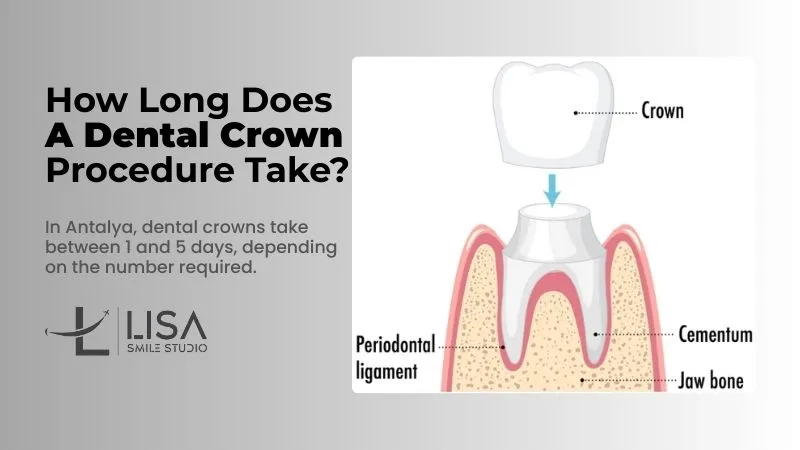
Once the plan has been established, the physical work on your tooth begins. The area surrounding the tooth is anesthetized with local anesthetic to ensure that the process is completely pain-free. The tooth preparation involves removing a layer of the outer enamel and dentin to allow the tooth to be reshaped to fit perfectly inside a rounded hole. Think of this similar to reshaping a wooden peg to fit perfectly inside a circular hole. The tooth must be shaped and reduced to a point where when the new crown is placed over it, the final result is not too large or too bulky. The crown must be the identical size as the original tooth to fit correctly within the bite.
How long does first crown appointment take?
On average, you can plan to spend 60 to 90 minutes in the dentist's chair. Times may vary depending on how complex the procedure is.
There are several factors to determine how much time this appointment will take. For example, if there was an old, failing filling that needs to be removed, or if there was extensive decay that requires a "core build-up" (filling material is added to the remaining portion of the tooth to enlarge it sufficiently to accommodate a crown) the appointment will likely last closer to 90 minutes. Although digital scanning can significantly shorten your appointment time, as opposed to the traditional gooey impression trays that need to be allowed to set for a few minutes in your mouth, some patients have smaller mouths or difficulty opening their mouths far enough to access the tooth. Both of these factors will extend the length of your appointment.
Temporary crown placement
Since the custom-made permanent crown will take time to arrive at the dental lab, your dentist cannot allow you to leave the office with a reduced-tooth size. The exposed dentin layer has numerous microscopic pore openings to the nerve within the tooth. These pores provide direct access to the nerve and if the tooth remains uncovered, the tooth will be extremely sensitive to both air and temperature changes.
Your dentist will create a temporary crown, usually made from a plastic-like resin material. The temporary crown will be cemented into place using weak adhesive cement. This is intentional as the temporary crown is designed to remain in-place for two days and then easily remove when the permanent crown is ready. The temporary crown serves three major functions: protecting the nerve to avoid sensitivity, maintaining the proper position of your gums, and preventing movement of the prepared tooth.
You will receive instructions for your temporary crown. Patients must avoid sticky foods such as caramel and/or gum as they could potentially pull the temporary crown completely off. Hard foods should also be avoided as they could crack the plastic temporary crown.
Dental crown procedure -Visit 2
The duration varies depending on the number of teeth treated, but the second visit is completed within one hour. The second visit is usually the most anticipated visit by many patients. During this “delivery” visit, the temporary crown is replaced with the final polished and durable ceramic or metal restoration. Generally, the second visit will be quicker and less invasive than the first visit.
Crown placement
During the visit to place your crown, the dentist removes the temporary crown using a pair of small forceps. Once the temporary crown is removed, the dentist cleans the area around the underlying tooth to remove the temporary cement and any debris that may have accumulated during the temporary crown’s stay on your tooth. The dentist then places the new, zirconia crown onto the tooth.
Final correction
After verifying that the crown fits properly, the dentist performs the most important verification of the crown fitting – the bite, also referred to as occlusion. A crown that is even slightly too high (we're talking about the thickness of a single strand of human hair) can cause extreme pain and discomfort later.
How long does second crown appointment take?
The delivery appointment is significantly shorter than the first appointment. Typically, the entire procedure will take anywhere from 20-60 minutes. If the lab technician has accurately represented the crown based on the original digital scan provided, the crown may literally just fall into place and no adjustments will need to be made, potentially completing the appointment in as little as 30 minutes.
However, if the contacts need to be adjusted or the occlusion needs to be altered, it could take up to an hour to complete. Additionally, the dentist may use advanced bonding cements to attach the crown to the tooth, which add additional time to the appointment since the cement must undergo multiple cycles of conditioning and light-curing to achieve maximum hardness. In addition to requiring additional time, aesthetic crowns placed on front teeth may take longer as well due to the dentist needing to polish the porcelain to achieve the ideal shine and texture.
Factors affecting the timeline for getting a dental crown
Most people receive dental crowns in two visits over a period of two weeks. There are many variables that can make the timing of receiving a dental crown either faster or slower. The greatest factor influencing the timing is Same-Day Technology (CAD/CAM). Those offices that use CAD/CAM technology can scan the tooth, create a crown using computer software and then milled into ceramic from a block of ceramic material. These same-day technologies eliminate both the need for a temporary crown as well as the second appointment. In a typical dental office that uses CAD/CAM technology, the preparation of the tooth for the crown; the design of the crown; milling of the crown; and cementing of the crown typically occur in one day and last anywhere from 2-4 hours.
How long does a crown take to heal?
Although technically a crown is an artificial object, and therefore cannot "heal," the living tissue surrounding the crown (tooth nerve and gums) must adjust to the new environment. Most people experience full adaptation of the tooth in approximately two to four weeks.
First few days: It is normal to have mild discomfort in the gums, particularly in the areas where the anesthetic was administered or where the margin of the crown rests. It is also common for the tooth to be sensitive to cold temperatures during this time. Both of these conditions occur due to irritation of the nerve caused by the vibrations from drilling and the cementation process. Typically this condition resolves itself within 48 hours.
1st week: The gums begin to appear healthy and firm once again, forming a tight seal around the new crown. If the tooth hurts while you chew, it is not a result of healing. More than likely the crown is slightly "high" in the bite. This is easily resolved by the dentist making a minor adjustment and should not be left uncorrected.
2-4 weeks:At this point, the sensation of having a foreign object in your mouth should dissipate. The brain becomes accustomed to the new shape of the tooth, and the sensation of cold temperatures should decrease significantly. Teeth that have previously undergone root canal treatment do not experience any sensitivity to temperature. Live-nerve teeth may require a slightly longer recovery time. If you continue to experience sharp pains after a month, or if your tooth continues to throb, it is a sign that the nerve is struggling to recover, and a follow-up appointment with the dentist is necessary.